It all started with an
interview given by the Minister of Consumer Affairs Alberto Garzón to The Guardian (here) where he insisted that the Spanish should eat less meat. While
the meat lobby were unhappy to read this (they’d heard it all before, last
summer, with Pedro Sánchez putting out the flames at the time by saying ‘I don’t know about you, but I enjoy a
nice steak, me’), they were incensed to read in a foreign newspaper that Garzón
contrasted ordinary extensive farming which, he says ‘…“is sustainable” with “what
isn’t at all sustainable is these so-called mega-farms … They find a village in
a depopulated bit of Spain and put in 4,000, or 5,000, or 10,000 head of
cattle. They pollute the soil, they pollute the water and then they export this
poor quality meat from these ill-treated animals’. Amen to the giant piggeries.
Understandably, the industry giants
and any opposition politician worth his salt is through the roof with righteous
rage. Telling the foreigners that our meat is shit.
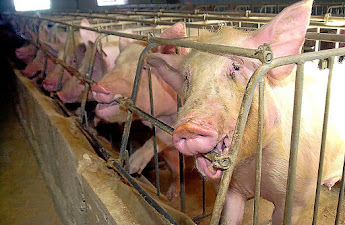
Mind you, who likes battery
farms, or pigs reared in a cage? Apart from the treatment of the animals
concerned, doesn’t the quality suffer too?
Several politicians have
asked for Garzón to recant (and then quietly resign); but he is standing firm.
Now it has become the leading
political issue of the moment, as the upcoming February 13th elections in Castilla
y León (a high-octane agricultural area currently under the control of the PP)
approach. The PP is almost certain to win the elections there, cue a sigh of
satisfaction from the Head Office in Madrid, but any extra push would be (excuse
the pun) popular – maybe enough to
govern without Vox as a slightly heathen partner.
While many are against this
betrayal of Spanish meat by a foolish lefty (Garzón is secretary of the Izquierda
Unida) and even some PSOE barons are raising their voices against him, there
are also many who agree that the macro-farms are doing major damage in various
ways. In the last six years, there are 35% more pigs in Spain than before, yet
the number of farms under 1,000 animals have dropped by 30% - showing that the larger, industry-owned macro-farms are becoming
the norm. The main problem though is the
massive amount of animal waste – called purín
in Spanish: a mixture of urine, poops and brown water – high in nitrogen, phosphorus
and potassium. It is used initially as fertiliser, but the excess can end up in
underground aquifers – with over 1,000 of these now affected according to the
Ministry of Ecology. Of course, the costs in these macro-farms are, per unit,
cheaper that traditional farms can match, leading producers to prefer them, and
in some cases, operate them themselves.
Some Notes from the Media:
Spanish News Today here: ‘Spain is the fifth largest exporter of meat in the world’.
It says that ‘Garzon’s contentious views could do untold damage to Spain’s meat
industry, which was worth over 7,000 million euros in foreign sales last year’.
LaSexta here: ‘Presidents Lambán (PSOE - Aragón) and Mañueco (PP -
Castilla y León) call for Garzón's resignation, claiming that he attacked
Spanish livestock in his interview in The
Guardian'.
AraInfo here: ‘A number of Aragonese environmental groups criticize the
Aragonese president Javier Lambán for "contradicting the decisions taken
by his own government" and "confusing the citizens." Equally (we read), they support Alberto Garzón
who "has done nothing more than defend a model that is based on extensive
cattle ranching and employment in our rural environment"…’. They are
calling for Lambán’s resignation (Heh).
elDiario.es here: The
president of Castilla-La Mancha Emiliano García Page (PSOE) also criticises
Garzón’s remarks – as does Vox and the PP. Then, it says, ‘…Garzón answered
first that the president of Castilla y León, Alfonso Fernández Mañueco, is
"desperate for far-right votes and that is why he is resorting to the lies
and manipulation from the lobbies"…’.
LaSexta here: ‘Garzón repeats his remarks: saying that he is right to
point out that the meat from macro-farms is "of worse quality". The
Minister for Consumer Affairs has also pointed out that his statements are
"impeccable" and that he made them "as minister, and not just as
a personal opinion"’.
La Razón, in
an opinion piece, says that we wait impatiently for the inevitable departure from
the government of the Minister of Consumer Affairs (and, we can infer, the welcome
collapse of the socio-communist regime).
NuevaTribuna
says ‘Industrial meat-farming aggravates depopulation while
causing a huge environmental impact’. It also says in the article that it’s
pretty obvious that poorly and cheaply fed animals will produce lower-quality
meat.
Then of course, there’s the
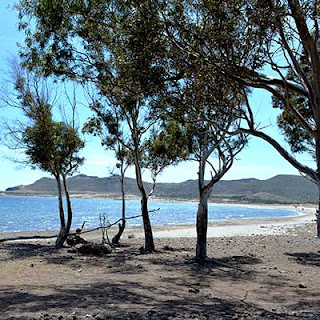
destruction of the Mar Menor – pretty much down to the pigs.
Segovia – where there are
eight pigs to every person – is also against the macro-farms. ‘We don't want to
be the pigsty of Spain’, they tell Epe
here.
From El Confidencial here, under the heading ‘the most meat in the least time
possible’, we visit a macrogranja ‘like
the ones Garzón talks of’. With video.
Greenpeace has
a brief video from a year ago here called ‘¡Macrogranjas no!’
Further afield, from El País here: ‘The increase in livestock and industrial agriculture has
a huge environmental cost, but Spain has not done enough to control and prevent
it. With this thesis, the European Commission has decided to bring Spain before
the Court of European Justice, with the understanding that this country has not
adopted sufficient measures to prevent water pollution caused by nitrates
derived from this activity, as required by community regulations…’.
Deutsche Welle
says that ‘Germany declares war on cheap meat’.
Meanwhile, says El País here, ‘The Netherlands has created a new ministry (of ‘Nature
and Nitrogen’) to reduce the impact of increasingly large pig farms. The
department will be responsible for reducing emissions from the entire livestock
sector in a country that has subsidized since 2019 the voluntary closure of pig
farms’.
…
It is, in short, a rift
between those who hope that life will continue in the way it’s been going, and
those who know that it can’t.